
ER Law
Unfair Dismissal Claims in 2025: What SMBs Need to Know
What Australian small and medium businesses need to know about unfair dismissal risk, the Small Business Fair Dismissal Code, and defensible process.
Employment Relations · SMB Risk
Unfair Dismissal Claims in 2025: What SMBs Need to Know
By Vrushali Suvarna
HR Specialist | ER/IR Practitioner | Founder, HRWise.com.au & Flex HR | May 2026
Abstract
Fair Work Commission applications are rising, unfair dismissal remains one of the largest claim categories, and small businesses are often exposed because the right process was not documented at the right time. This article explains the key legal thresholds, the Small Business Fair Dismissal Code, and a practical checklist for defensible dismissal decisions.
The Wake-Up Call No SMB Owner Wants
Picture this: it's a Tuesday morning, and a business owner I worked with - let's call her Priya - calls me in a panic. She'd let go of a long-term employee the week prior. She felt she'd done everything right: a verbal warning six months ago, a conversation about performance, a final meeting. What she hadn't done was document any of it. Three days later, an unfair dismissal application landed in her inbox. The next six weeks cost her $14,000 in legal fees and a conciliation settlement - for a business with eleven staff.
This story is not unusual. In 2025, it's becoming the norm.
The Scale of the Problem
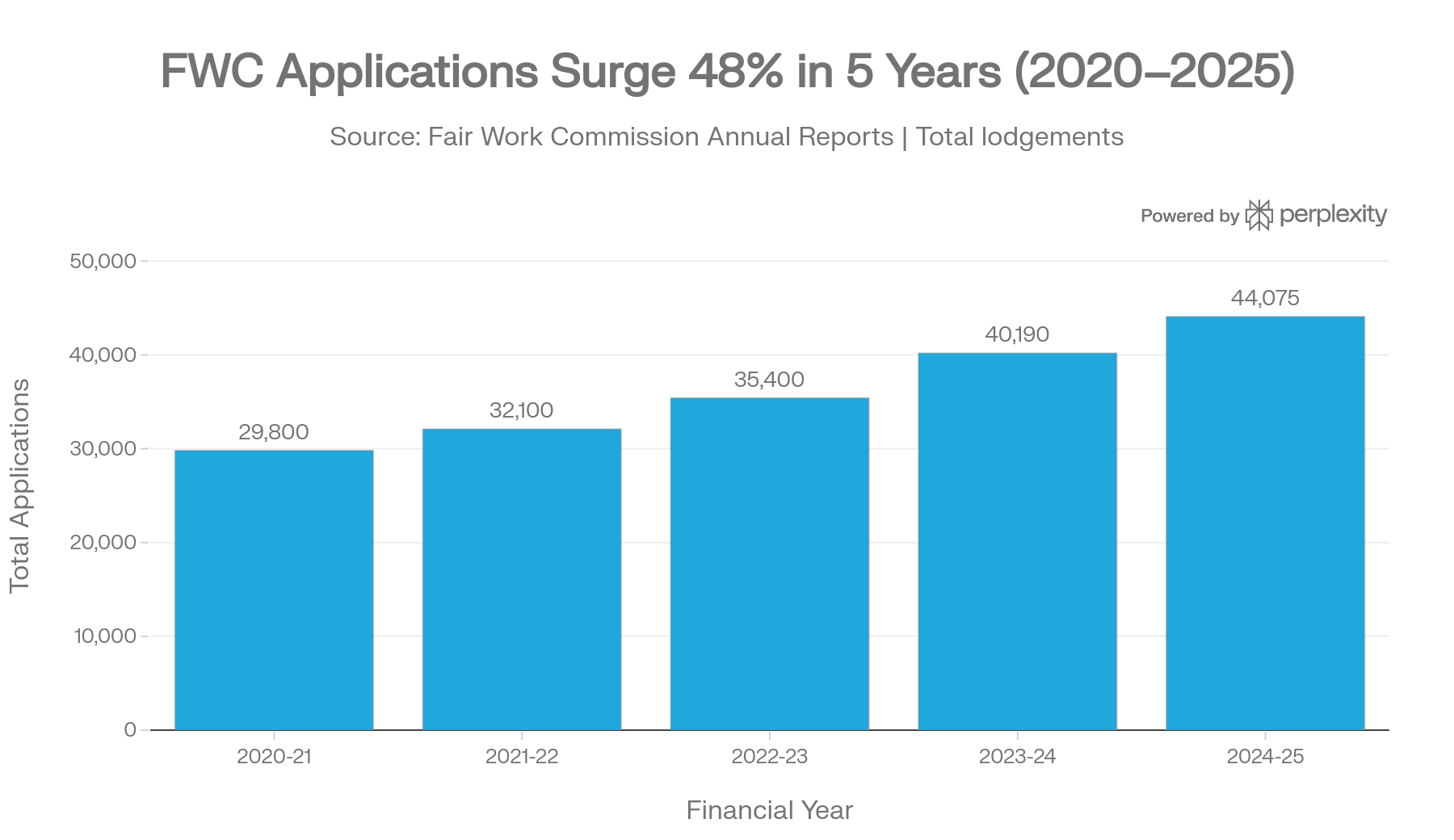
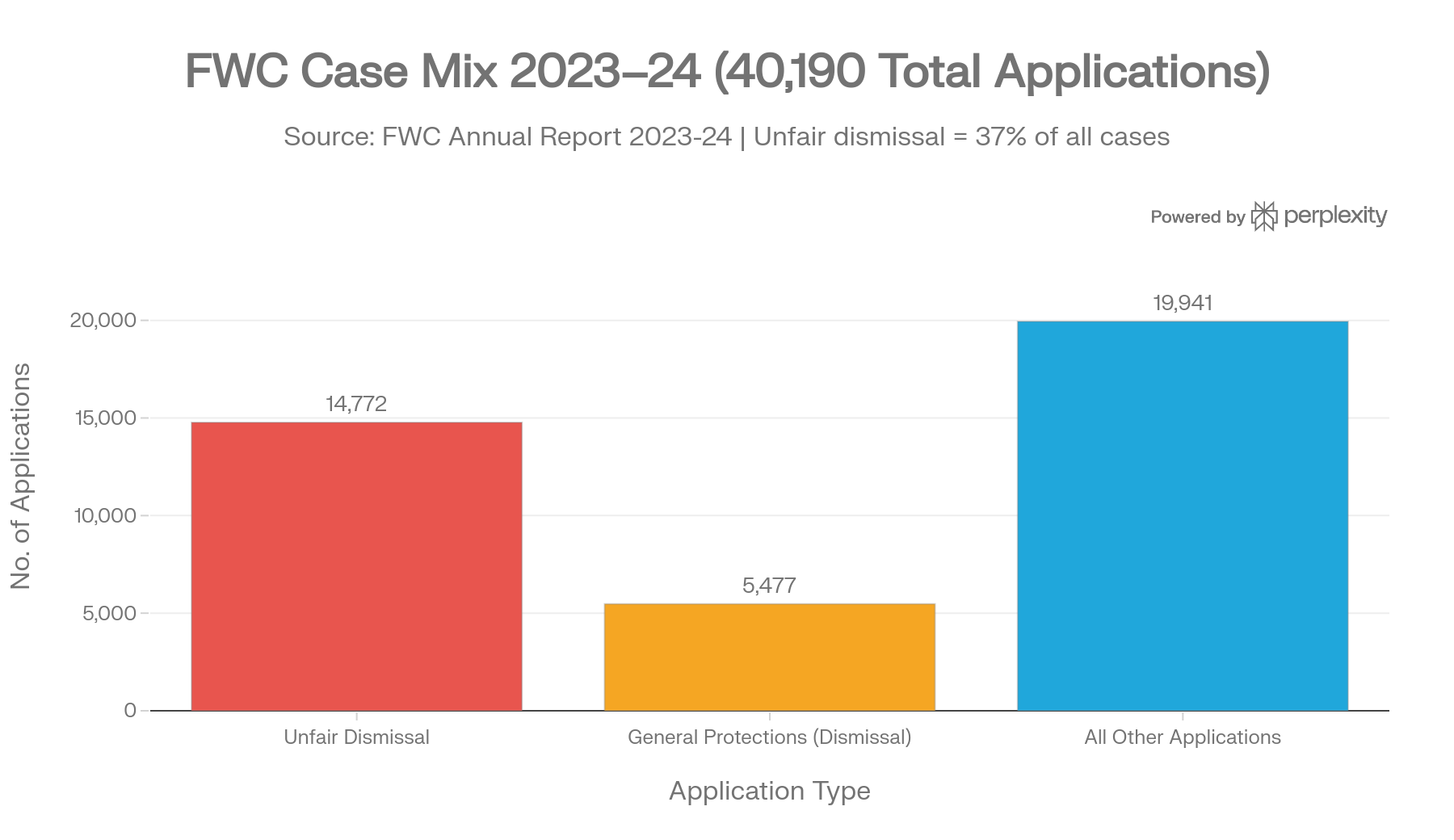
The Fair Work Commission (FWC) received 44,075 total applications in 2024–25 - 24% above the five-year average and nearly 50% higher than 2020–21. Unfair dismissal applications are one of the two largest case types driving that surge. In 2023–24 alone, 14,772 unfair dismissal cases were lodged - 37% of all FWC applications that year.
The FWC's own President has described the caseload as 'unsustainable.' For SMBs [small-to-medium businesses], these numbers represent risk, cost, and reputational exposure that most don't have the HR infrastructure to absorb. In Q1 of 2025–26, applications already exceeded the 3-year average by 45% - the trajectory is accelerating, not slowing.
What the Law Actually Requires of Small Businesses
Under the Fair Work Act, a small business is defined as any employer with fewer than 15 employees, including regular and systematic casuals. If you meet that threshold, a specific legal tool exists to protect you - the Small Business Fair Dismissal Code.
The Code works as a shield: if you follow it properly, a dismissed employee cannot succeed in an unfair dismissal claim, even if they're unhappy with the outcome. The key protections it provides are:
- Extended minimum employment period: Employees of small businesses must have worked for at least 12 months before they're eligible to claim unfair dismissal, compared with 6 months for larger employers.
- Summary dismissal protection: You may terminate immediately, without notice or warning, where the employee's conduct is serious enough, such as theft, fraud, violence, or a serious WHS breach, provided you have reasonable grounds.
- Performance-based dismissal: For capacity or conduct issues that aren't serious misconduct, you must provide a clear reason for the risk of dismissal, a warning, a genuine opportunity to improve, and the chance to have a support person present at the dismissal meeting.
The Three Most Common Mistakes SMBs Make
Based on 14 years in ER consulting, the patterns are remarkably consistent. Most unfair dismissal claims against small businesses don't arise because the employer made the wrong decision - they arise because the employer can't prove the right process was followed.
1. Verbal warnings only, with no written record
Even a brief email summary sent to the employee after a conversation constitutes admissible evidence. If it's not in writing, it didn't happen.
2. Skipping the opportunity to respond
Employees have a right to hear the case against them and respond before a decision is made. Announcing a decision in the same meeting as presenting the concern is a procedural failure the FWC regularly identifies.
3. Conflating performance and misconduct processes
Summary dismissal, with no warning and no notice, is reserved for serious misconduct. Applying it to persistent underperformance is a common and costly error - the two pathways have entirely different procedural requirements.
A Practical Framework: The SMB Dismissal Checklist
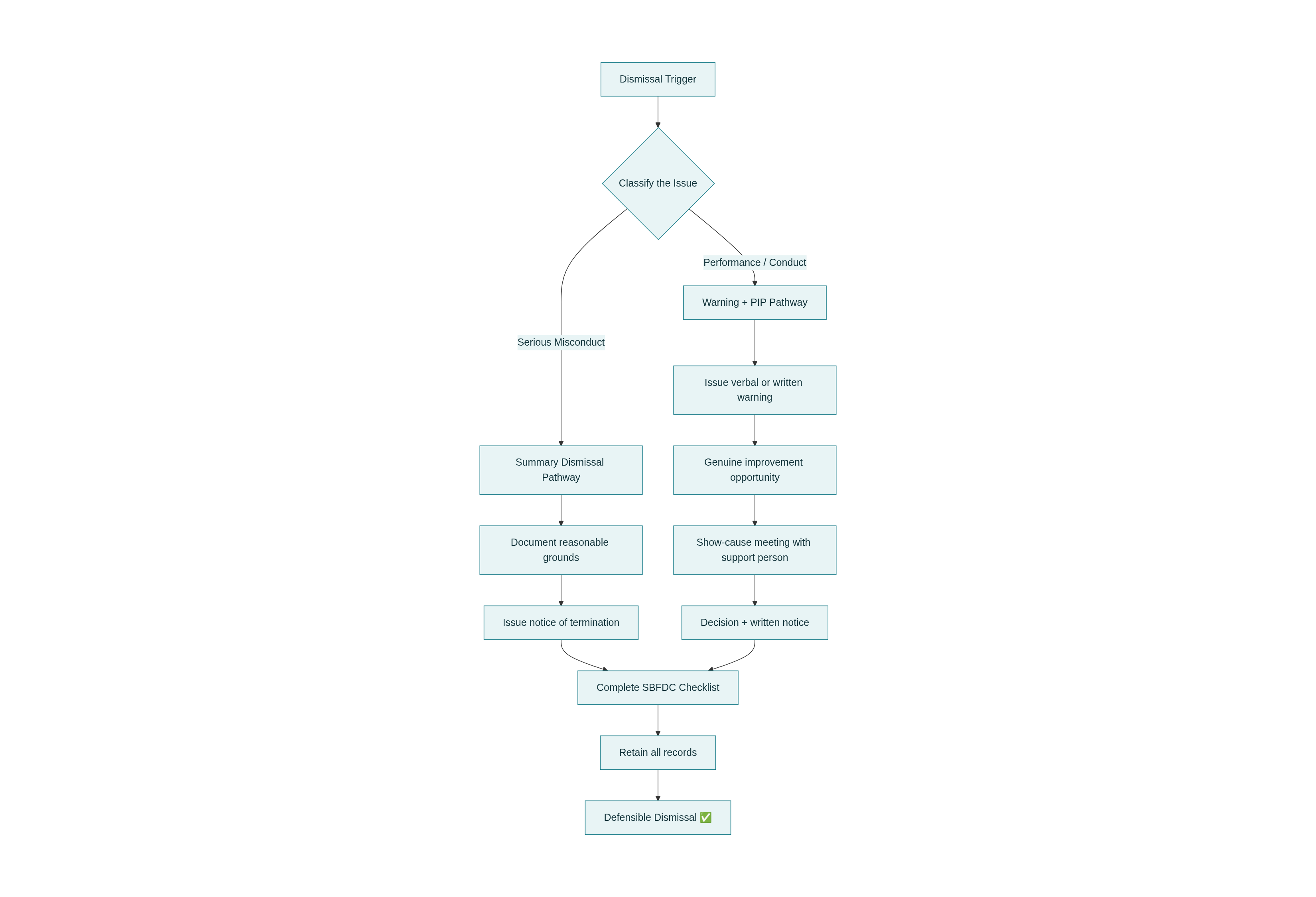
Use this four-step framework before any dismissal decision, whether you're dealing with misconduct or performance:
Step 1 - Classify correctly
Is this serious misconduct, or a conduct or capacity issue that requires a warning and performance improvement pathway? Consult the Code's definitions before proceeding.
Step 2 - Document in real time
Warnings, meetings, responses, and improvement plans should be recorded at the time they occur - not reconstructed afterwards.
Step 3 - Show-cause before you decide
Provide the employee with written notice of the specific reason and a genuine opportunity to respond, in person, with a support person if requested.
Step 4 - Complete the Code checklist
The FWC publishes an official Small Business Fair Dismissal Code Checklist. Completing and retaining this document at the time of dismissal is one of the most straightforward defences available to you.
Jurisdiction Snapshot: Key SMB Thresholds
| Threshold | Min. Employment Period | Code Applies? | Compensation Cap 2025–26 |
|---|---|---|---|
| < 15 employees (small business) | 12 months | Yes | $91,550 |
| ≥ 15 employees | 6 months | No | $91,550 |
Source: Fair Work Commission 2025–26; Small Business Fair Dismissal Code 2011.
How HRWise.com.au and Flex HR Help
Documentation discipline and process consistency are exactly the gaps HRWise.com.au was built to close. The platform walks HR managers and business owners through the correct procedural pathway for any dismissal scenario - serious misconduct, underperformance, or redundancy - and generates real-time documentation prompts so nothing falls through the cracks at the moment it matters most.
For SMBs that need deeper, ongoing support - particularly through a live investigation or complex termination - Flex HR provides fractional ER consulting. You get the same rigour as an in-house ER team, without the overhead.
Key Takeaways
| Key Point | What It Means for You |
|---|---|
| FWC applications hit 44,075 in 2024–25 | A 24% spike above the five-year average - and small businesses are not insulated. |
| < 15 employees = small business | The Small Business Fair Dismissal Code is your primary legal protection - but only if you follow and document it. |
| 12-month employment period | A critical window for SMBs - but it does not apply to general protections claims, which have no minimum employment threshold. |
| Three common failures | No written warnings, skipping the opportunity to respond, and misclassifying misconduct vs. performance. |
| Real-time documentation wins | Reconstructed paperwork after the fact rarely withstands FWC scrutiny. Document at the time, every time. |
References
- Fair Work Commission. Annual Report 2024–25. fwc.gov.au
- Fair Work Commission. Annual Report 2023–24. fwc.gov.au
- Fair Work Commission. President's Statement on Reforms to General Protections, May 2026. fwc.gov.au
- Gadens. "A System Under Strain: The Unsustainable Rise in Fair Work Commission Applications." December 2025. gadens.com
- Citation Group. "FWC Puts Businesses on Notice: 27% Surge in Cases." 2025. citationgroup.com.au
- COSBOA. "Unfair Dismissal Claims Surge Highlights Urgent Need to Modernise Small Business Definition." 2025. cosboa.org.au
- Lawpath. "What's The Small Business Fair Dismissal Code? (2026 Update)." March 2026. lawpath.com.au
- Peninsula Group. "Small Business Fair Dismissal Code." April 2026. peninsulagrouplimited.com.au
- Fair Work Commission. "Compensation for Unfair Dismissal - Compensation Cap 2025–26." fwc.gov.au
- Fair Work Commission. "Dismissal Rules for Small Business Owners." fwc.gov.au
About the author
Vrushali Suvarna
HR/ER specialist, HRWise.com.au founder, Flex HR consultant
Vrushali writes about practical employee relations, AI-enabled HR triage, and flexible people support for growing Australian organisations.
Connect on LinkedIn