
AI in HR
AI in the Commission: When the Robot Lawyer Gets It Wrong
What an AI hallucination in a Fair Work Commission matter means for HR teams, employers, and AI use in employment proceedings.
Abstract
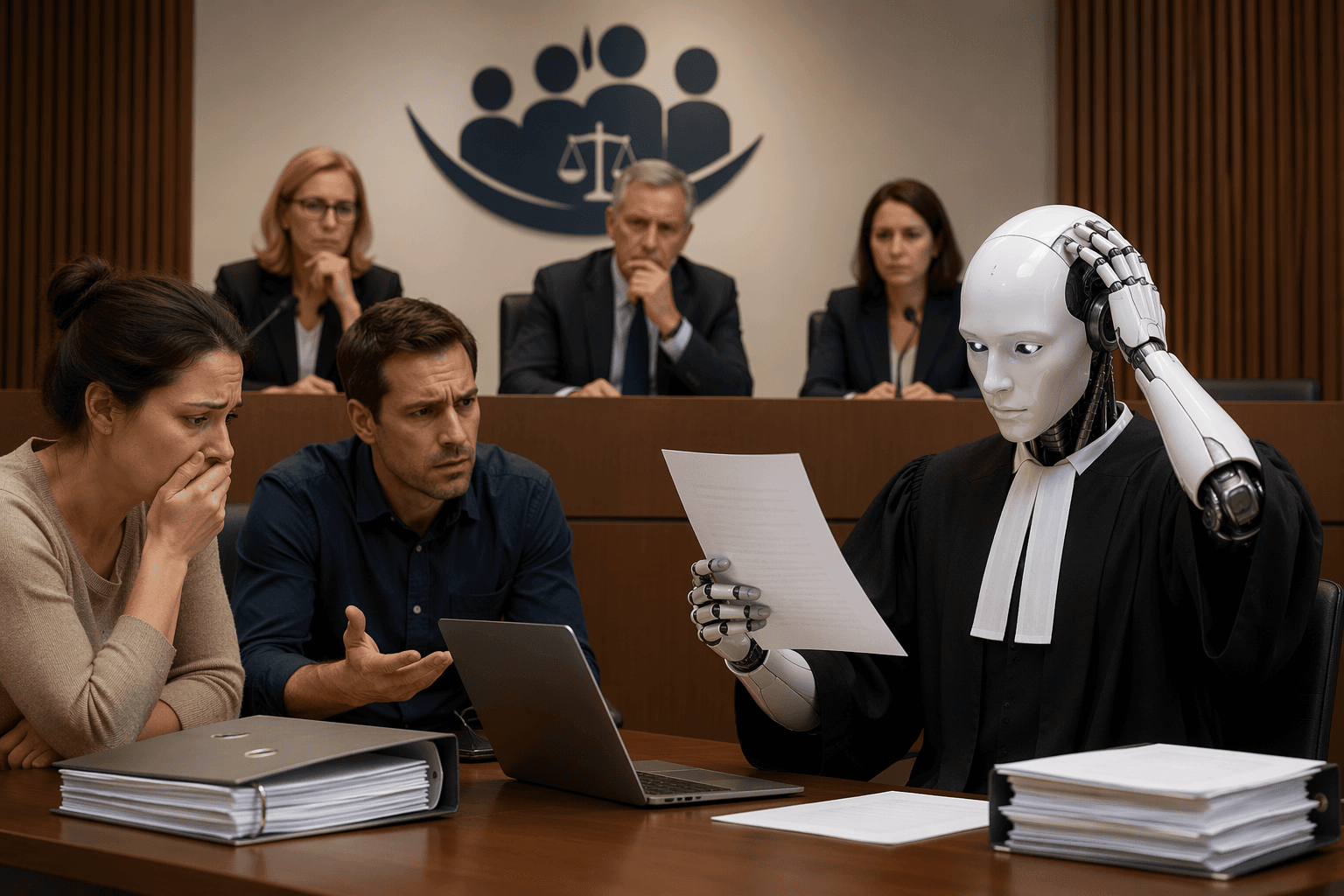
In early 2026, the Fair Work Commission dismissed a general protections claim and did something it almost never does: invited the employer to apply for costs. The reason was not a weak case on the merits. It was that the employee had used AI tools to draft his submissions - and those submissions cited contract clauses and Award provisions that did not exist.
Deputy President Lake described the arguments as incoherent and the misrepresentations as deliberate.
Hoverd v M & J D Pty Ltd [2026] FWC 1013 is the first publicly reported Australian case in which AI-generated hallucinations directly caused an adverse outcome in employment tribunal proceedings. It will not be the last.
This case study examines what happened, what the FWC has done in response, and what it means for HR practitioners and employers.
1. The Case: What Actually Happened
Reece Hoverd worked for M & J D Pty Ltd, a Queensland earthmoving firm. A dispute arose after his employer temporarily changed his shift times and directed him to perform labouring duties. Hoverd resigned and filed a general protections application with the Fair Work Commission, claiming constructive dismissal - a forced resignation due to a repudiation of contract or adverse action by the employer.
The employer's position was straightforward: this was a resignation, not a dismissal. The Commission determined the jurisdictional question first - was there a dismissal at all?
It found clearly that there was not. The proposed shift change was temporary, required only one week's notice under the Award, and Hoverd had alternatives to resigning. The application was dismissed on jurisdiction.
But the jurisdictional finding was not the story.
The applicant has repeatedly displayed a disregard for facts and has relied on incoherent legal arguments in order to contrive a basis to claim compensation.
2. The AI Problem: Hallucinated Law
During the proceedings, Hoverd admitted using AI tools to help organise and draft his submissions, while maintaining the underlying material was based on his own knowledge and documents.
Deputy President Lake found otherwise.
The submissions relied on specific clauses from Hoverd's employment contract and the Waste Management Award 2020. When the Commission examined those clauses, they did not exist. Contract clauses were materially altered or fabricated entirely. Award provisions cited were not in the Award at all.
Hoverd was warned during proceedings about providing false or misleading evidence. He continued to rely on the non-existent clauses anyway - including in closing submissions, after being specifically told the Award provision he was citing did not exist. He only conceded the errors when reminded he was giving sworn evidence.
Ignorance of the law is one thing. But repeatedly saying that the Applicant's written contract says something which it does not say is not mere ignorance; it is a deliberate misrepresentation.
3. The Costs Exposure: Why This Decision Is Extraordinary
The Fair Work Commission is not a costs-bearing jurisdiction in the ordinary sense. Under the Fair Work Act, each party typically bears their own costs regardless of outcome. Costs orders are reserved for situations where a party has acted vexatiously, unreasonably, or caused the other party unnecessary expense.
After dismissing the application, Deputy President Lake went further - stating explicitly that he welcomed a costs application from the respondent employer.
For practitioners, that is not a throw-away line. It is the Commission signalling that repeated reliance on fabricated legal content, even after correction, had crossed the threshold for costs exposure.
The employer had engaged a solicitor and filed clear, well-supported submissions. Ashurst has noted the stark contrast in quality between the two parties' materials as a factor in the adverse assessment. Well-prepared employer submissions, held against AI-generated incoherence, can produce not just a dismissal of the claim - but a costs order.
4. The FWC Response: Three New Rules for GenAI
FWC President Adam Hatcher has publicly stated the Commission has seen a sharp increase in applications where AI tools have given weak claims a "sheen of legal plausibility." He has described AI-generated material as capable of being "inaccurate, incomplete, out of date, or just made up."
On 24 March 2026, the FWC published an exposure draft of its proposed Guidance Note: Use of Generative Artificial Intelligence in Commission Cases.
The draft sets out three binding requirements for any document prepared with AI assistance and lodged in Commission proceedings.
Disclose AI use
Any application, response, submission, witness statement, or other document lodged in a Commission case must disclose that GenAI was used in its preparation. Failure to disclose is itself a compliance issue, independent of the accuracy of the content.
Verify all details
All references to facts, legislation, and case law must be verified as correct and relevant. The submitting party - not the AI - bears responsibility for accuracy. Citing a hallucinated Award clause is not a defence. In Hoverd, it was an aggravating factor.
Confirm personal knowledge in witness statements
Where the AI-assisted document is a witness statement or declaration, the witness must separately confirm the content is based on their own knowledge and is true to the best of their belief. AI drafting does not displace the personal sworn obligation.
The Guidance Note is expected to be implemented through amendments to the Fair Work Commission Rules 2024. Industry body AREEA has called for a broader crackdown, noting AI has "dramatically lowered the effort required to produce lengthy applications" and the FWC is bearing the cost of screening unmeritorious claims at scale.
5. What This Means for HR Practitioners
The AI-in-employment-law story has two sides. Employees are using AI to generate claims they might not otherwise have brought, or to construct legal arguments they do not understand. But employers and HR teams are also increasingly using AI to draft contracts, policies, correspondence, and - critically - responses to Fair Work proceedings. The risks run in both directions.
5.1 Responding to AI-Generated Claims
| Risk | What to Do |
|---|---|
| Opposing submissions cite non-existent clauses | Document inaccuracies and raise them with the Commission immediately |
| AI-generated applicant materials continue after correction | Keep records - this pattern supports a costs application |
| Your own team using AI to draft submissions | Apply the same three FWC rules to your own documents: disclose, verify, confirm |
| Fabricated Award provisions in opposing materials | Cross-reference against the actual Award and put findings on the record |
5.2 Drafting Contracts and Policies with AI Tools
AI-generated contract clauses carry hallucination risk. The same mechanism that fabricated Award provisions in Hoverd's submissions can fabricate compliance provisions, notice periods, or Award references in AI-drafted employment contracts. Every AI-generated clause requires verification against the actual source instrument.
AI cannot reliably interpret ambiguous Award provisions. Modern Awards are complex, frequently varied, and contextually dependent. AI tools generate confident-sounding interpretations that may be legally wrong. Verification against the Award directly is not optional.
Your documentation remains your defence. The employer in Hoverd was protected not by legal sophistication but by accurate records and well-prepared submissions. The documentation gap between the parties was itself a factor in the outcome.
GenAI tools can assist litigants to produce applications, responses, submissions and witness statements, but the material generated can be inaccurate, incomplete, out of date, or just made up.
6. The Global Picture
Hoverd v M & J D sits within a rapidly expanding global pattern of AI-employment law collision.
In the United States, Mobley v. Workday Inc. resulted in a federal court granting preliminary class certification in May 2025 under the Age Discrimination in Employment Act - the first nationwide collective action against an AI vendor for allegedly screening out applicants over 40 through automated hiring tools.
In January 2026, Kistler et al. v. Eightfold AI Inc. was filed in California, alleging that AI hiring scores generated without disclosure function as consumer reports under the Fair Credit Reporting Act - with potential statutory damages of $100–$1,000 per profile across a database of over one billion workers. Commentators describe these two cases as a pincer movement: vendor-as-agent liability from one direction, transparency and disclosure obligation from the other.
| Jurisdiction | Case | Year | Issue | Status |
|---|---|---|---|---|
| Australia | Hoverd v M & J D Pty Ltd [2026] FWC 1013 | 2026 | AI hallucinations in FWC submissions | Claim dismissed; costs invited |
| USA | Mobley v. Workday Inc. | 2025 | AI hiring tool screening out older workers | Preliminary class cert. granted |
| USA | Kistler et al. v. Eightfold AI Inc. | 2026 | Undisclosed AI scoring as consumer report | Filed; ongoing |
| Australia | Davitkov v Woolworths [2026] FWC 1655 | 2026 | AI-assisted submissions in FWC proceedings | Decided |
Australia does not yet have AI-specific hiring regulations equivalent to California's Automated Decision Systems rules (effective October 2025). But anti-discrimination law already applies to AI-assisted decisions, and the FWC's GenAI guidance signals that the era of unregulated AI in employment proceedings is over.
7. How HRWise.com.au and Flex HR Help
HRWise.com.au is built on verified employment law source material - Award provisions, the Fair Work Act, and National Employment Standards - with source flagging and verification prompts integrated into the workflow. It does not generate Award interpretations without identifying the source instrument and prompting the user to verify.
The Hoverd decision is a textbook illustration of what happens when that verification step is skipped.
For employers facing FWC proceedings - particularly where the opposing party is relying on AI-generated materials - Flex HR provides practitioner support to identify inaccuracies, prepare accurate responses, and preserve costs applications where warranted.
- 1Hoverd v M & J D [2026] FWC 1013 is the first Australian case where AI hallucinations directly caused an adverse FWC outcome, including rare costs exposure for the applicant.
- 2The applicant cited clauses and Award provisions that did not exist and continued to rely on them after correction. The Commission found deliberate misrepresentation, not mere ignorance.
- 3Deputy President Lake invited a costs application after dismissing the claim - a near-unprecedented step directly linked to the AI-fabricated content and conduct after correction.
- 4FWC published draft GenAI guidance on 24 March 2026 with three binding requirements: disclose AI use, verify all content, and confirm personal knowledge in witness statements.
- 5FWC President Hatcher flagged a 70% workload increase linked to AI-generated claims giving weak cases a sheen of legal plausibility.
- 6The risk is bilateral AI submissions expose applicants to costs; AI-drafted contracts and hiring tools expose employers to discrimination and compliance liability.
References
- Hoverd v M & J D Pty Ltd [2026] FWC 1013 (Deputy President Lake). fwc.gov.au
- Fair Work Commission. President's Statement and Draft Guidance Note: Use of Generative Artificial Intelligence in Commission Cases. 24 March 2026. fwc.gov.au
- Information Age (ACS). AI Blunder Lands Worker in Legal Trouble. 1 April 2026. ia.acs.org.au
- South Geldard Lawyers. AI in Fair Work Commission Cases. April 2026. southgeldard.com.au
- Ashurst. Costs Orders as a Shield: Combating the Rise of AI-Driven Unmeritorious Claims. 2026. ashurst.com
- LEAP Legal Software. AI Hallucinations & Costs Risk in the FWC: Hoverd v M & J D. 3 May 2026. leaplegalsoftware.com/au
- AREEA. AREEA Calls for Fair Work Claims Crackdown as AI-Fuelled Applications Explode. 11 May 2026. areea.com.au
- Fair Workplace Solutions. Using AI for Your Unfair Dismissal Claim? Here's What the FWC Now Requires. 29 March 2026. fairworkplacesolutions.com.au
- HCA Magazine. AI is Flooding Australia's Employment System. 19 April 2026. hcamag.com
- Anthony Davitkov v Woolworths Group Limited [2026] FWC 1655 (Deputy President Colman).
- Mobley v. Workday Inc., US District Court N.D. California. Preliminary Collective Certification, 16 May 2025.
- Kistler et al. v. Eightfold AI Inc., Contra Costa County Superior Court, California. Filed January 2026.
- JD Supra. AI Hiring Under Fire: Algorithmic Screening Enters The Chat. 9 April 2026. jdsupra.com
Vrushali Suvarna is an HR and Employment Relations specialist with 14 years of experience across industrial relations, employee relations, workplace investigations, and compliance. She is the founder of HRWise.com.au, an AI-powered ER triage tool for Australian HR teams, and Flex HR, a fractional HR consulting service for SMBs.
About the author
Vrushali Suvarna
HR/ER specialist, HRWise.com.au founder, Flex HR consultant
Vrushali writes about practical employee relations, AI-enabled HR triage, and flexible people support for growing Australian organisations.
Connect on LinkedIn